- ShreeHistory
- History
- Hits: 340
- ShreeHistory
- History
- Hits: 340

The Sarvatobhadra temple represents one of the most sophisticated planning systems in ancient Hindu architecture, and its principles became the fundamental blueprint for major monuments built during the Mughal period in India, particularly Humayun's Tomb and the Taj Mahal. This architectural connection reveals the deep indigenous roots underlying structures commonly attributed solely to Islamic architectural traditions
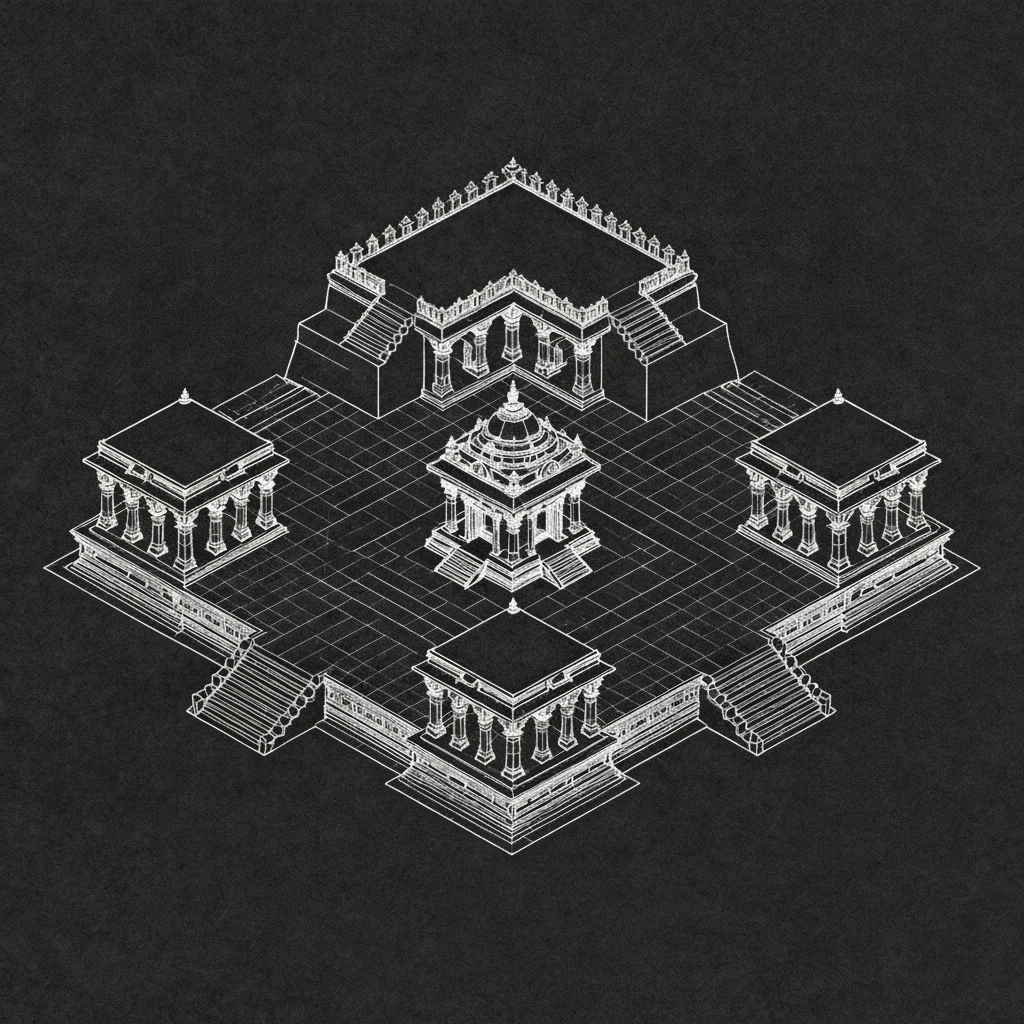
The Sarvatobhadra temple, described in detail in the Vishnudharmottara Purana (an ancient Hindu text on architecture), belonged to the eighth classification of Hindu sacred structures. The name derives from sarvata (from every side) and bhadra (auspicious), indicating a temple characterized by auspiciousness and accessibility from all directions.
The Sarvatobhadra temple exhibits distinctive elements that make it unique among Hindu architectural forms:
1. Elevated Square Platform (Jagati)
The temple rests on a broad, square terrace called jagati—a raised platform that serves multiple purposes including circumambulation (pradakshina) and establishing sacred space. This elevation creates both practical and symbolic separation from the mundane world.
2. Central Sanctum (Garbha-griha)
At the heart of the plan sits the square garbha-griha (literally "womb-house"), the innermost sanctum housing the primary deity. This represents the cosmic center, the axis mundi connecting heaven and earth.
3. Four Mandapas in Cardinal Directions
Surrounding the central sanctum are four mandapas (pavilions or halls) extending in the four cardinal directions—north, south, east, and west. This creates a cruciform or cross-shaped plan radiating from the center.
4. Four Corner Chambers (Prasadas)
Between the four mandapas, in the diagonal corners, sit four smaller chambers or subsidiary shrines (prasadas). This arrangement creates what R. Nath describes as an "octagonalized-square plan" when the corners are chamfered.
5. Four-Way Accessibility
The Sarvatobhadra features entrances at all four cardinal points, allowing approach from any direction. Staircases on each of the four sides of the platform provide access.
6. Enclosing Rampart (Prakara)
A surrounding wall or prakara defines the sacred precinct, with subsidiary shrines (devakadis) positioned at the corners of the terrace.
7. Sacred Water Features
Integrated into the design are beautiful tanks and water channels arranged around the central shrine on the terrace, serving both ritual and aesthetic purposes.
8. Panch-Ratna Symbolism
The temple embodied the panch-ratna (five-jewel) formula: one central shikhara (tower) over the garbha-griha and four subsidiary shikharas over the four mandapas, creating a cluster of five towers with the central one dominating.
Multiple ancient Hindu architectural texts describe the Sarvatobhadra:
Vishnudharmottara Purana provides the most elaborate description in its 87th chapter of the third part, devoting an entire chapter to this unique temple type
Matsya Purana (Chapter 269) specifies that Sarvatobhadra temples should bear many shikharas
Brhat-Samhita prescribes four doors, many domes, many beautiful chandrashala (moon-shaped arch forms), five storeys, and a breadth of twenty-six cubits
Visvakarmaprakasha and Samarangana-Sutradhar also document this temple form with variations in measurements and proportions
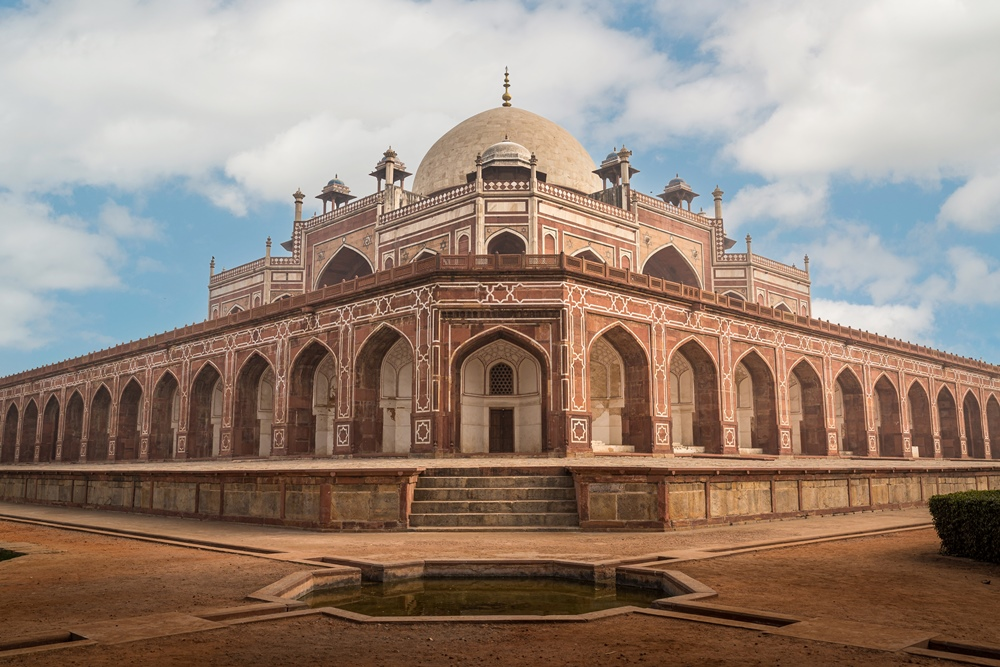
When Humayun's Tomb was constructed between 1564-1570 in Delhi, the structural correspondence to the ancient Sarvatobhadra temple plan became unmistakable. R. Nath, in his doctoral dissertation "The Immortal Taj Mahal," makes this connection explicit.
Plan Configuration: The Octagonalized Square
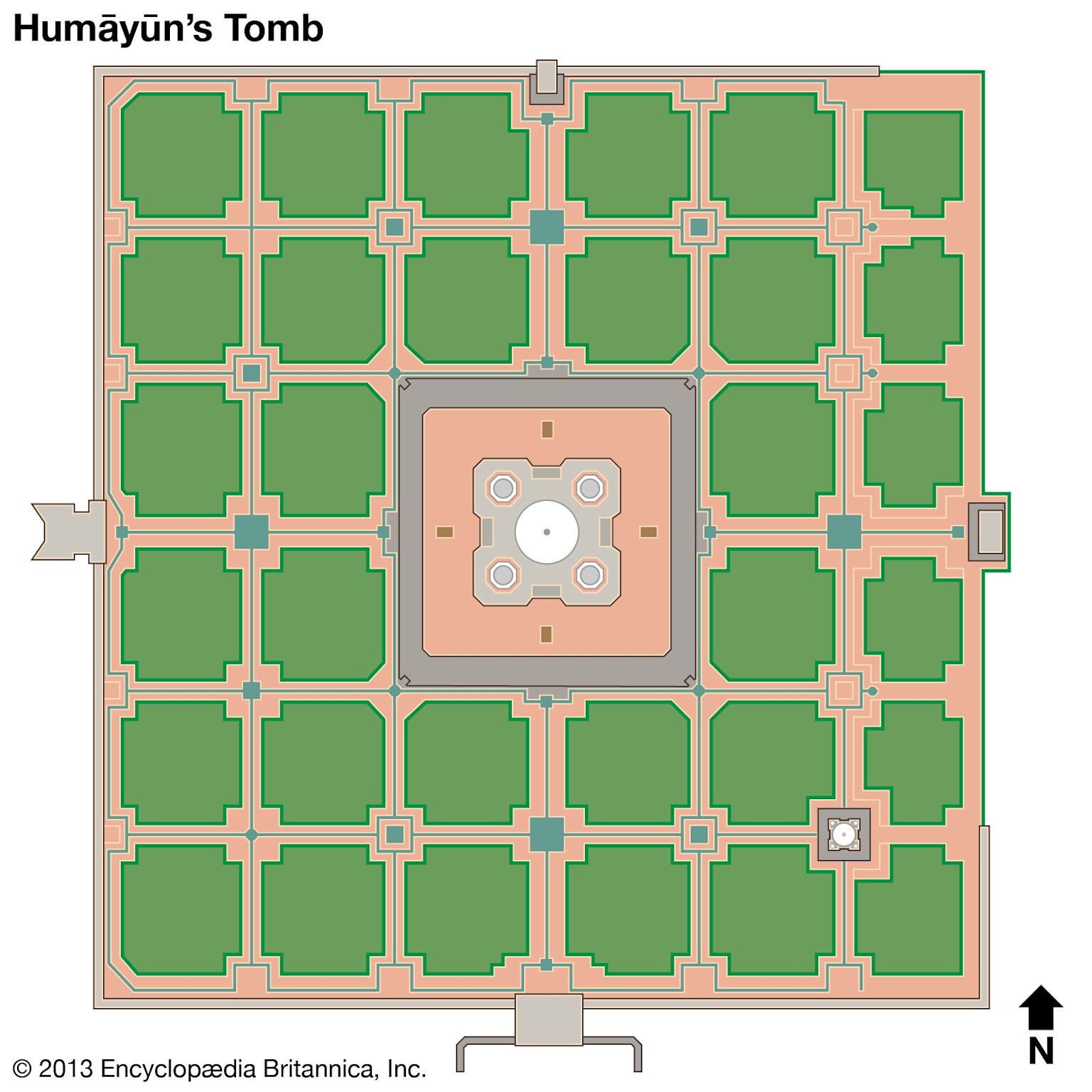
The tomb sits on a raised plinth 22 feet (6.71 meters) high, directly paralleling the elevated jagati of Hindu temples. The main structure follows a square plan measuring 156 feet (47.54 meters) per side, with its angles chamfered (cut at an angle), thus creating an octagonalized square—precisely the Sarvatobhadra configuration.
R. Nath explicitly states: "This description fundamentally corresponds to the plan of the tomb of Humayun and as there is no such prototype traceable in Persia or any other Islamic country". This unequivocal scholarly acknowledgment establishes that the planning system derives from indigenous Hindu architectural traditions, not from Persian or Islamic sources.
Interior Arrangement: Garbha-griha and Surrounding Chambers
The interior spatial organization replicates the Sarvatobhadra system with remarkable precision:
Central octagonal chamber: Functions as the garbha-griha, the focal point of the entire structure
Four octagonal corner chambers: Correspond to the four corner prasadas of the temple plan
Four side rooms: Represent the four cardinal mandapas
Interconnecting passages: All spaces connect through corridors, creating the circumambulatory (pradakshina) path characteristic of Hindu temples
R. Nath further identifies this arrangement with the Hemakuta temple system, which featured an Andhakarika (dark ambulatory)—a circumambulatory passage surrounding the central garbha-griha, enclosed within outer walls. He concludes: "This was known to the Indian builder and so the interior plan of the tomb probably owes its origin to him rather than to Mirak Mirza Ghiyas or any other Islamic builder".
Four-Way Accessibility: Cardinal Direction Gateways
Like the Sarvatobhadra temple, Humayun's tomb complex has gateways in all four cardinal directions. The main entrance on the west corresponds to Hindu temple orientation principles, which sometimes place primary entrances facing west for Shiva temples, as prescribed in the Shulba Sutras.
Each gateway provides axial approach to the central tomb, maintaining the four-fold symmetry inherent in the Sarvatobhadra concept. The pathways from each gateway lead directly to the central structure, preserving the Hindu principle of approaching the sacred center from multiple auspicious directions.
Water Features: Sacred Hydraulics
Small tanks and water channels integrate into the platform design, paralleling the sacred water features prescribed for Sarvatobhadra temples. The hydraulic system includes:
Overhead tanks ensuring water pressure
Underground earthen pipes feeding fountains
Channels (chadars) with flowing water
Lily ponds at intervals
Fountains marking cardinal and intercardinal points
This sophisticated water engineering reflects Hindu understanding of sacred hydraulics, where water represents purification, prosperity, and the flow of cosmic energy.
While Babur introduced the Persian char-bagh (four-part garden) concept to India, providing the landscape setting, the architectural plan of the tomb structure itself derives entirely from the Hindu Sarvatobhadra system.
R. Nath clarifies: "The square plan of the main structure, approachable from all the four sides, was however known to the Indian builder since ancient times". The indigenous architect adapted the ancient Sarvatobhadra plan to the new context of tomb construction, demonstrating continuity of Hindu architectural knowledge systems.
The char-bagh garden, divided into four quadrants by water channels, actually resonates with Hindu cosmological concepts of four-part spatial division found in vastu purusha mandala (the sacred geometric diagram underlying Hindu architecture). The four cardinal directions hold deep significance in Hindu thought, corresponding to directional deities (dik-palakas) and cosmic ordering principles.
In a sealed conference hall in Islamabad last year, a retired Pakistani general delivered a blunt message to a gathering of strategists. “Pakistan does not have a No First Use policy, and I’ll repeat that for emphasis. Pakistan does not have a No First Use policy,” declared Lt. Gen. Khalid Ahmed Kidwai, former head of the nation’s Strategic Plans Division. Across the border, India’s leaders publicly espouse the opposite stance – a doctrine pledging that India would not be the first to launch nuclear weapons. But behind these divergent nuclear postures lies a worrisome reality: both South Asian rivals are quietly expanding their atomic arsenals, refining their missiles, and straining a fragile deterrence with new ambiguities.
\documentclass{article}
\usepackage{amsmath, amssymb, geometry, xcolor}
\geometry{a4paper, margin=1in}
\title{Understanding \textbf{Varga} and \textbf{Nija} in Sanskrit Mathematics}
\author{Perplexity AI}
\date{\today}
\begin{document}
\maketitle
\section*{Introduction}
The terms \textbf{varga} (वर्ग) and \textbf{nija} (निज) are fundamental to interpreting classical Indian mathematical texts like Aryabhata’s \textit{Aryabhatiya}. Their meanings and contextual usage reveal critical insights into ancient mathematical methodologies.
\section{\textbf{Varga} (वर्ग): The Concept of "Square"}
\subsection{Literal Meaning}
\textbf{Varga} translates directly to "square" or "group" in Sanskrit. In mathematics, it specifically denotes:
\begin{itemize}
\item The \textbf{square} of a number (e.g., \textit{pañcavarga} = \(5^2 = 25\))
\item A \textbf{class} or \textbf{category} of numbers (e.g., odd/even \textit{varga})
\end{itemize}
\subsection{Mathematical Applications}
Aryabhata uses \textit{varga} extensively:
\begin{itemize}
\item \textbf{Square of a number}:
\textit{Yavad vargād vargaśodhanaṃ} ("Subtract the square from the square as much as possible") refers to algebraic operations involving squares.
\item \textbf{Area of a square}:
\textit{Vargaṃ caturasraṃ} ("A square is quadrilateral") implies \textit{varga} as a geometric square.
\item \textbf{Astronomical cycles}:
\textit{Varga} also denotes divisions of planetary orbital periods.
\end{itemize}
\subsection{Example from \textit{Aryabhatiya} (Verse 2.3)}
\begin{quote}
\textit{Vargādvargaṃ śuddhiḥ} \\
("The purification [result] from the square of squares")
\end{quote}
This likely refers to iterative squaring in astronomical calculations.
\section{\textbf{Nija} (निज): The Nuanced Meaning of "Own"}
\subsection{Literal Meaning}
\textbf{Nija} means "own," "inherent," or "intrinsic." It emphasizes a \textbf{self-contained property} of an object.
\subsection{Mathematical Context in \textit{Aryabhatiya}}
In the sphere volume formula:
\begin{quote}
\textit{तत्र निजमूले हतं घनगोलः फलं त्रिघ्नविशेषम्} \\
(\textit{tatra nijamūle hataṃ ghanagolaḥ phalaṃ trighnaviśeṣam})
\end{quote}
\subsection{Interpretation Challenges}
\begin{itemize}
\item Traditional translation: "multiplied by its own square root" \\
\( V = \pi r^2 \times \sqrt{\pi r^2} \approx 1.77\pi r^3 \)
\item Problem: Overestimates true volume (\( \frac{4}{3}\pi r^3 \)) by 33\%.
\end{itemize}
\subsection{Reinterpreting \textbf{Nija} as a Geometric Ratio}
Scholars argue \textit{nijamūle} may instead mean \textbf{"inherent base ratio"}:
\begin{align*}
\text{If } \textit{nijamūle} &= \frac{4}{3} \times r \text{ (radius):} \\
V &= \pi r^2 \times \frac{4}{3}r = \frac{4}{3}\pi r^3
\end{align*}
\section*{Conclusion}
The term \textbf{nija} exemplifies how Sanskrit mathematical texts encode complex ideas through compact phrasing. Aryabhata’s formula, when decoded as \( \frac{4}{3}\pi r^3 \), reveals a sophisticated understanding of solid geometry that parallels Archimedes’ work.
\end{document}
Gingee Fort, located in present-day Tamil Nadu, was a formidable stronghold consisting of three citadels on separate hills. Its strategic location made it crucial for:
Controlling trade routes between the Deccan and South India
Providing a secure base for Maratha operations against Mughal forces
Maintaining links with southern kingdoms like Thanjavur and Madurai
After Sambhaji's execution in 1689, Rajaram Bhosale undertook a daring 18-month journey to Gingee:
Traveled 1,200 kilometers through hostile territory
Led by Khando Ballal and Santaji Ghorpade
Used disguises and diversionary tactics to evade Mughal patrols
Reached Gingee in November 1690
Rajaram declared Gingee the new Maratha capital:
Fortified defenses under engineer Govind Pant Bundela
Created supply networks with local Tamil chieftains
Appointed Santaji Ghorpade and Dhanaji Jadhav as mobile field commanders
Aurangzeb dispatched a massive army under Zulfiqar Khan:
100,000 troops including elite cavalry
Heavy artillery and siege equipment
Support from local Nawabs and chiefs
The defenders employed multiple tactics:
Three-tiered defense system:
Outer perimeter of mobile cavalry
Middle ring of fortified positions
Inner citadel strongholds
Supply Management:
Underground granaries stocked for years
Secret water channels and reservoirs
Hidden paths for reinforcements
Under Santaji Ghorpade and Dhanaji Jadhav:
Regular raids on Mughal supply lines
Night attacks on enemy camps
Coordination with forces in Maharashtra
Rajaram's wife Tarabai emerged as a key leader:
Organized intelligence networks
Managed diplomatic relations with southern kingdoms
Supervised fort logistics and morale
The siege proved costly for Aurangzeb:
Multiple commanders replaced due to failure
Massive expenditure on maintaining siege forces
Growing desertion rates among troops
In 1698, Rajaram executed a brilliant escape:
Used diversionary attacks by Santaji Ghorpade
Slipped through Mughal lines during monsoon
Returned to Maharashtra to lead resistance
The fort finally fell to Zulfiqar Khan in January 1698:
Most defenders had already evacuated
Minimal strategic gain for Mughals
Enormous resources wasted in 8-year siege
Depleted Mughal Resources:
Estimated 100 million rupees spent
Loss of experienced commanders
Demoralization of troops
Maratha Advantages:
Time gained for reorganization in Maharashtra
Proof of defensive capabilities
Enhanced prestige among southern powers
Weakened Mughal Authority:
Demonstrated limits of imperial power
Encouraged other rebellions
Strained treasury resources
Maratha Resurgence:
Established southern presence
Developed new military leaders
Built alliance networks
The siege influenced later warfare:
Emphasis on mobility over fixed defenses
Integration of local support networks
Importance of supply chain disruption
Remembered in Maratha history as:
Symbol of resistance against overwhelming odds
Example of strategic depth in warfare
Inspiration for later independence movements
Primary Sources:
Akhbarat-i-Darbar-i-Mualla
Chitnis Bakhar
Dutch East India Company records
Modern Studies:
"The Marathas 1600-1818" by Stewart Gordon
"Military System of the Marathas" by S.N. Sen
"The New Cambridge History of India: The Marathas 1600-1818"
The Siege of Gingee represents a crucial chapter in Maratha military history, demonstrating their ability to conduct complex defensive operations while maintaining offensive capabilities. It marked a turning point in the Mughal-Maratha conflict, proving that the Marathas could sustain resistance even when driven from their homeland.